Available via backorder
€ 1.707,31
Victron Lithium battery 25.6V/100Ah Smart – We'd be happy to provide you with more information about this product. Please contact us.
Available via backorder
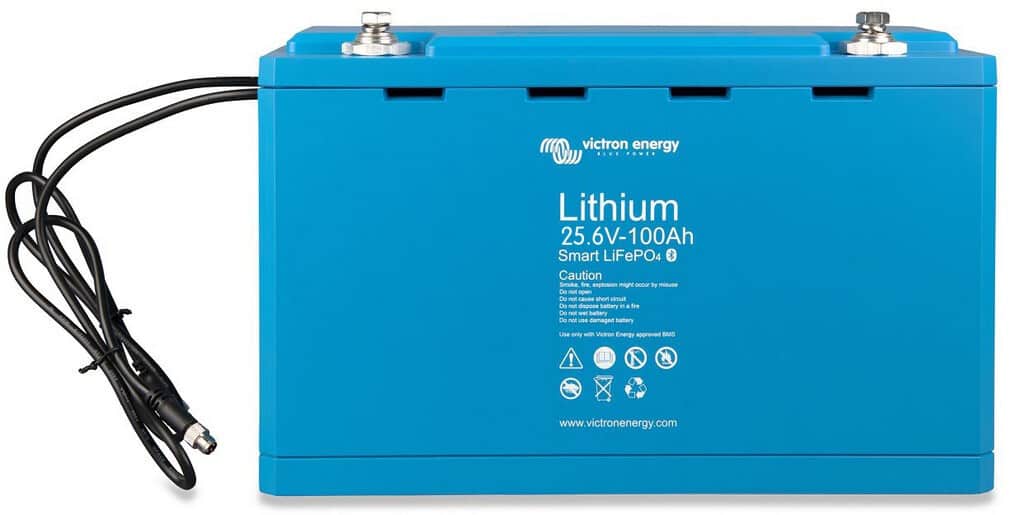
Victron Lithium battery 25.6V/100Ah Smart
The Victron 25.6V/100Ah Smart lithium iron phosphate battery has a maximum continuous discharge current of 200A, and is equipped with built-in Bluetooth functionality for reading the integrated cell balancing and cell monitoring. The battery is equipped with cables with connectable M8 plugs that can be connected to each other in a ring network. This allows the battery to be connected to an external battery management system (BMS). Up to 5 batteries can be connected in parallel and up to 4 batteries in series. Battery Management System (BMS) The VE.bus BMS is connected to the communication cables with connectable M8 plugs. The most important functions are: > Disconnects or switches off the load when the voltage of a battery cell falls below 2.5V. > Stops the charging process when the voltage of a battery cell rises above 4.2V. > Switches the system off when the cell temperature rises above 50°C. Why lithium iron phosphate? Lithium iron phosphate (LiFePO4 or LFP) is the safest of the main lithium-ion battery types. The nominal voltage of an LFP cell is 3.2V (lead-acid: 2 V/cell). A 12.8V LFP battery therefore consists of 4 cells connected in series; and a 25.6V battery consists of 8 cells connected in series. Robust A lead-acid battery will fail prematurely due to sulphation: • If it operates in deficit mode for extended periods (if the battery is rarely or never fully charged). • If it is kept partially charged, or worse, completely discharged (in a yacht or mobile home during the winter). An LFP battery does not need to be fully charged. The lifespan is even slightly longer by partially instead of fully charging the battery. This is a major advantage of LFP compared to lead acid. Other advantages include a wide operating temperature range, excellent cycle performance, low internal resistance and high efficiency (see below). LFP is therefore the right choice for very demanding applications. Efficient Energy efficiency can be of essential importance in various applications (especially with autonomous solar and/or wind energy). The energy efficiency cycle (discharge from 100% to 0% and charged back to 100%) of the average lead-acid battery is 80%. The energy efficiency cycle of an LFP battery is 92%. The charging process of lead-acid batteries becomes particularly inefficient when the 80% state of charge is reached, resulting in efficiencies of 50% or even less in solar systems that require several days of reserve energy (battery operating at a state of charge of 70% to 100% works). However, an LFP battery still has an efficiency of 90% with light discharges. Comparison with lead-acid batteries LFP batteries are more expensive compared to lead-acid batteries. But in demanding applications, the high initial costs are more than offset by the longer service life, superior reliability and excellent efficiency. An LFP battery saves up to 70% of space and is up to 70% lighter in weight. Bluetooth Bluetooth allows cell voltages, temperature and alarm status to be monitored. Very useful to locate (potential) problems, such as cell imbalance.
We'd be happy to provide you with more information about this product. Please contact us.
robust-mt.nl