Charging an electric boat is simpler than most people expect. Yet, in practice, it raises many questions: how long does it take, what does it cost, and which charger do you need? In this article, we explain step-by-step how charging an electric boat works, from shore power in the harbor to home charging and fast charging. This way, you know exactly what you need and what to expect.
Table of contents
How does charging an electric boat work?
An electric boat battery operates on direct current (DC). The electricity grid and shore power in the marina supply alternating current (AC). Therefore, every electric boat has a built-in or external battery charger that converts AC to DC, so that the energy is stored safely and efficiently in the battery.
In practice, you connect the boat to power and the system automatically handles the rest. Modern lithium battery systems are controlled by a Battery Management System (BMS) that monitors the charging process: it prevents overcharging, keeps an eye on the temperature, and extends the lifespan of the cells.
Doubts about your charging setup?
From our workshop in Monster, we regularly assess existing installations for efficiency and safety. Contact us today for a consultation.
Where can you charge an electric boat?
There are six main methods for charging an electric boat, each with its own advantages and disadvantages. Which one suits you best depends on your boating profile, battery capacity, and the system used.
-
Shore power (harbour)
Most commonly used. Simple, available everywhere in the Netherlands. -
At home
Practical when the battery is removable. You can easily take the battery home and charge it there via a suitable charging point. Handy for smaller electric boats or situations where charging in the harbor is less practical. -
Solar panels.
Good addition. Not suitable as a primary charging method. -
DC fast charging
High charging speed. Limited availability, growing rapidly. -
Wind energy
is interesting as a supplementary energy source, especially for longer trips or when the boat is often stationary. The yield depends on wind force and location. -
Hydrogeneration
involves generating energy from flowing water or the movement of the boat. It is particularly suitable as a backup during longer voyages, but less common as the primary charging method.
Shore power in the marina
Virtually every marina in the Netherlands has shore power connections on the jetty. You connect the boat with a shore power cable, and the built-in or external charger takes over. The connection is usually fused at 10 amperes. At 230V, this provides a charging capacity of 2.3 kW. Sufficient for most boats, but slightly slower than home charging.
Check with the harbour master in advance what voltage and amperage are available, and whether the shore power connection is compatible with your charging system.
Charging at home with a removable battery
For smaller electric boats or systems with a removable battery, you can easily take the battery home and charge it there. This can often be done via a suitable socket or charging point, depending on the battery type and the accompanying charger. In many cases, charging at home is faster than charging via shore power in the harbor, for example, if you have a 16A connection at home.
The major advantage is that you are not dependent on the charging infrastructure in the port. You take the battery with you, charge it safely, and place it back on board before departure. Always pay attention to the proper charging environment, ventilation, and the battery supplier's regulations.
Solar panels as a supplement
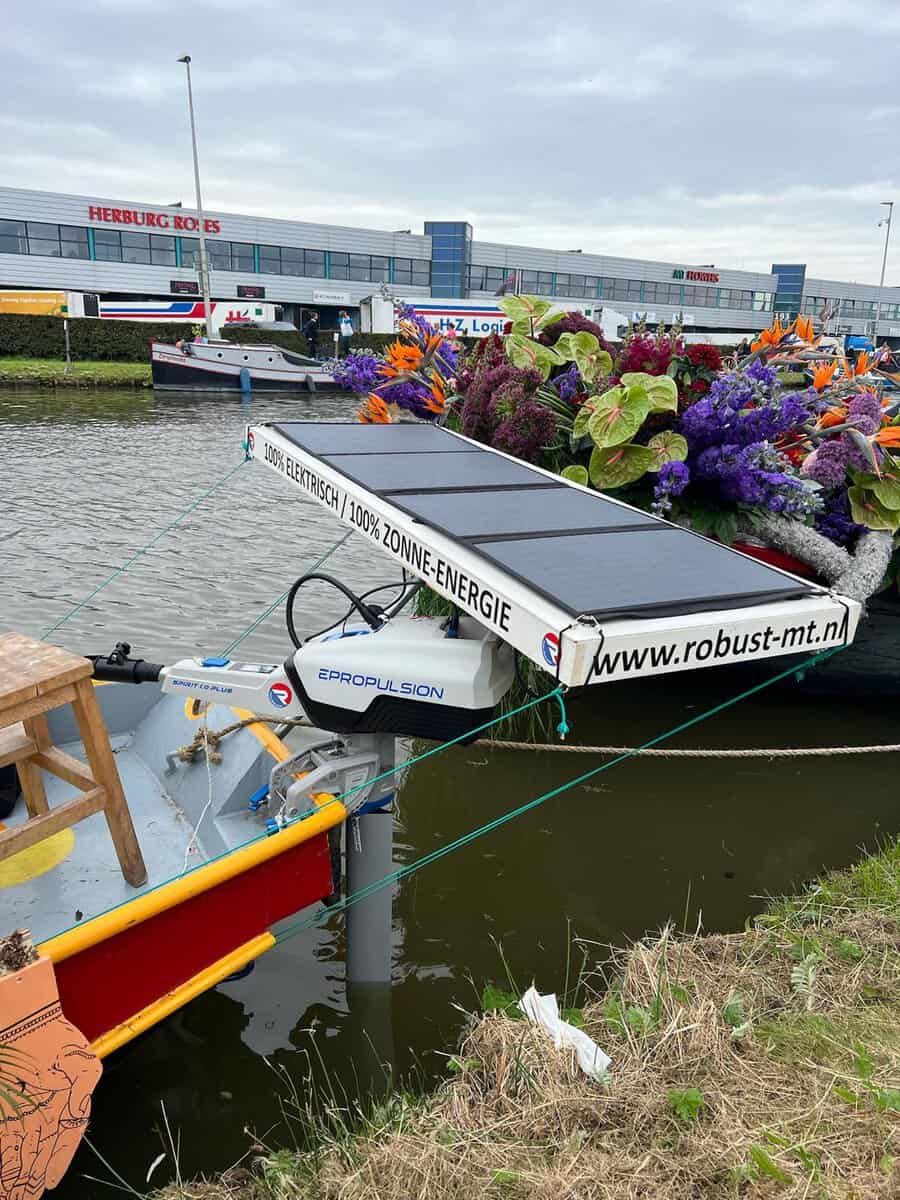
Solar panels on a boat are a valuable addition to your charging system. They compensate for standby power consumption on board and can feed back a portion of energy consumption during longer moorings. However, as a primary charging method, they fall short for most users. The yield is too low and too weather-dependent to charge a completely empty battery pack.
Do you want to combine solar panels with your drive system? Then proper integration with the BMS and the right MPPT charger is essential. We would be happy to advise you on this from our workshop.
Fast charging, DC
DC fast charging refers to charging the battery directly with direct current, without an internal inverter. This enables charging speeds of more than 20 kW, comparable to fast charging in an electric car. The number of DC charging points for boats in the Netherlands is growing rapidly, particularly in busy water sports areas.
Not every battery system supports DC fast charging. Check whether your battery and BMS are compatible with this before scheduling it as a standard method.
Wind energy on board
Wind energy can be an interesting supplementary charging solution, especially when the boat is stationary for extended periods or used for longer trips. With a small wind generator, energy can be generated to recharge the battery, depending on wind strength, location, and the chosen system.
In practice, wind energy is usually not sufficient as the primary charging method for an electric boat. The yield varies significantly and depends on the circumstances. However, it can help to partially offset on-board consumption and increase the range or autonomy on the water.
Hydrogeneration while sailing
In hydrogeneration, energy is generated by the movement of water past a generator or propeller. While sailing, the system can convert part of the kinetic energy into electricity, which recharges the battery.
Hydrogeneration is particularly interesting for longer voyages and situations where the boat is moving frequently. It is usually not a complete replacement for shore power or home charging, but it can serve as smart support within a broader charging system. Here too, proper coordination with the battery pack, the charge controller, and the BMS is important.
How long does it take to charge?
The charging time depends on three factors: the battery capacity (kWh), the available charging power (kW or A), and the initial state of the battery. The table below provides a practical overview for common battery sizes.
| Battery capacity | Shore power harbor (10A / 2.3 kW) | Home (16A / 3.7 kW) | Fast charger (DC, 11 kW) |
| 2 kWh (small sloop) | ± 1 hour | ± 40 min | ± 15 min |
| 5 kWh | ± 2.5 hours | ± 1.5 hours | ± 30 min |
| 10 kWh | ± 4.5 hours | ± 2.75 hours | ± 55 min |
| 20 kWh | ± 9 hours | ± 5.5 hours | ± 2 hours |
| 40 kWh (large boat) | ± 17.5 hours | ± 11 hours | ± 3.75 hours |
Charging times are calculated from 10% to 90% charge level (typical for lithium). A full charge cycle (0–100%) takes slightly longer due to the decrease in charging current at a high charge level.
Please note: the actual charging time depends primarily on the charger you use. Not only is the battery capacity a determining factor, but also the charging power of the built-in or external charger. For example, a battery might be suitable for a higher charging power, but if the charger does not support this, charging will still take longer. Therefore, always check what charging power your charger can handle and whether this is properly matched to the battery pack. We are happy to help you set up the optimal setup!
Practical tip
For most day trips, you don't need to charge the battery from completely empty to fully full. Just plugging in briefly and charging for 30–60 minutes quickly provides an extra 20–30% range for a lithium battery.
How much does it cost to charge an electric boat?
The cost of charging an electric boat is significantly lower than for a comparable petrol or diesel boat. The final cost depends on two factors: the battery capacity (kWh) and the current electricity price per kWh. The table below provides an overview of the expected charging costs for the most common battery sizes.
| Battery capacity | Costs at €0.25/kWh | Costs at €0.35/kWh | Costs at €0.50/kWh |
| 2 kWh | ± €0,40 | ± €0,56 | ± €0,80 |
| 5 kWh | ± €1,00 | ± €1,40 | ± €2,00 |
| 10 kWh | ± €2,00 | ± €2,80 | ± €4,00 |
| 20 kWh | ± €4,00 | ± €5,60 | ± €8,00 |
| 40 kWh | ± €8,00 | ± €11,20 | ± €16,00 |
Calculated based on a full charging cycle (0–100%). With daily use, you typically charge from approximately 20% to 90%, which further reduces costs.
Comparison with gasoline
A day of boating on petrol easily costs €15 to €30 or more, depending on engine power and duration. A full charge of a 10 kWh battery costs on average less than €3 at current electricity prices. This makes electric boating structurally four to ten times cheaper for daily use.
Electricity prices in the harbor can be slightly higher than at home. Some harbors charge a fixed connection fee per night; others bill per kWh. Check this with the harbor master in advance to avoid any surprises.
Which charger do I need?
The correct charger depends on four factors: the battery type, the battery voltage, the desired charging speed, and the available connection. An incorrectly chosen charger can lead to incorrect charging voltage, cell damage, or a drastically shortened lifespan.
Lithium (LiFePO₄) batteries
Modern drive batteries are almost always lithium iron phosphate (LiFePO₄). These batteries require a charger matched to the exact cell voltage profile of lithium; never use a charger intended for lead-acid or AGM batteries. A good lithium charger works in conjunction with the BMS and automatically switches to maintenance mode as soon as the battery is fully charged.
Voltage: 12V, 24V, 48V, 96V or 400V
Most small electric sloops operate on 24V or 48V. Larger propulsion systems (such as the ePropulsion G-series or Torqeedo Power-series) operate at higher voltages. Always check the system voltage of your drive battery and choose a charger that is matched to it.
For more powerful electric drives, higher voltages, such as 96V, are often used. Larger and professional drive systems, for example for heavy boats or work vessels, can even utilize high-voltage systems up to 400V.
Therefore, always check the system voltage of your drive battery and choose a charger that is matched to it. Incorrect voltage can lead to malfunctions, damage to the battery pack, or an unsafe charging system.
Charging current and charging speed
A 10A charger charges slower than a 30A one. Calculate roughly: charging current (A) × voltage (V) = charging power (W). A 30A charger at 48V delivers 1,440 W; a 10 kWh battery will then be fully charged in approximately 7 hours. With a 60A charger at 48V, this drops to 3.5 hours.
Charging and battery life
How you charge a battery directly affects how long it lasts. Modern lithium battery systems are much more forgiving than older lead-acid batteries, but a few basic principles significantly extend their lifespan:
- Do not charge to 100% for daily use. Lithium cells last longest between 20% and 85% charge levels. Fully charging makes sense for a longer boat trip, but not for everyday use.
- Do not leave the battery completely discharged for extended periods. Deep discharge (below 5–10%) accelerates cell aging. A good BMS prevents the motor from pulling as soon as the battery is critically low. – this applies in any case, preferably not below 20%
- Ensure a suitable temperature during charging. Preferably charge at a temperature above 5°C. Charging in freezing temperatures causes structural damage to lithium cells.
- Always use a compatible, certified charger. A poor-quality charger or one with a non-standard charging profile can irreversibly damage the cells.
- Charge the battery to approximately three-quarters before winter storage. For long-term storage, a charge level of 60 to 80% is ideal. Therefore, do not fully charge the battery, but ensure it is around 75% before the boat goes into winter storage. Subsequently, check the battery every 4 to 6 weeks and top up lightly if necessary.
Modern LiFePO₄ batteries are designed for 2,000 to 4,000 full charge cycles. With proper use and a well-tuned system, a lifespan of 10 years or more is achievable.
Doubts about your charging setup?
From our workshop in Monster, we regularly assess existing installations for efficiency and safety. Contact us for a consultation.
Frequently asked questions about charging an electric boat
How long does it take to charge an electric boat?
The charging time depends on the battery capacity and the available charging power. A 10 kWh battery charges via shore power in the harbor (2.3 kW) in approximately 4.5 hours. At home via a wall socket (3.7 kW), this takes approximately 2.75 hours. With an 11 kW DC fast charger, the same battery is fully charged in less than an hour.
How much does it cost to charge an electric boat?
At an electricity price of €0.35/kWh, charging a 10 kWh battery (from 10% to 90%) costs approximately €2.80. A day of boating on petrol easily costs €15 to €30 or more.
Can I charge an electric boat using shore power in the marina?
Yes. Virtually every marina in the Netherlands has shore power connections on the jetty. The connection is typically 230V/10A, which provides a charging capacity of 2.3 kW. You will need a compatible shore power cable and charger. Check with the marina in advance to see what amperage is available.
May I charge a lithium boat battery intermittently?
Yes. Lithium iron phosphate (LiFePO₄) batteries do not suffer from the memory effect and can be charged at any time. Intermediate charging during a docking stop has no negative effect on the lifespan.
Which charger do I need for an electric boat battery?
You need a charger that is matched to the battery type (lithium/LiFePO₄) and the system voltage (12V, 24V, or 48V). Never use a lead-acid charger for a lithium battery. An intelligent multi-phase charger that works with the BMS is the best choice. At Robust-MT, we always recommend a charger that is matched to the complete system.
Can I charge my electric boat at home?
Yes. If the boat is on a trailer or moored behind the house, you can simply charge via a wall socket (16A, 230V) or a fixed charging connection. Charging at home is generally faster than charging via shore power in the harbor, because the circuit breaker at home is set to 16A instead of 10A.
Are there charging stations for electric boats in the Netherlands?
Yes. The number of charging points for electric boats in the Netherlands is growing rapidly. In addition to standard shore power in harbors, more and more municipalities and watersports locations are investing in specific charging infrastructure for electric boating. DC fast chargers for boats are still in limited supply but are gaining ground.
How do I store the battery during the winter?
Charge the battery to 60–80% before winter storage and store it in a dry, frost-free location. Check the charge level every 4–6 weeks. Storing a battery completely discharged or fully charged significantly shortens its lifespan.